
Vendor Overview
Adobe is an enterprise content supply chain and digital experience platform enabling scalable content operations, personalisation, and workflow automation within regulated environments.
Adobe is not a single ‘pharma tool’; it is a content supply chain and digital experience engine, spanning creation, digital asset management (DAM), workflow automation, analytics, and personalisation.
Buyer Decision Logic
Step 1: Entry Trigger
Is your primary bottleneck content velocity and MLR throughput?
- Yes → continue
- No → consider CRM / orchestration-first solutions
Step 2
Do you operate at a scale where content reuse, modularisation, and governance materially impact performance?
- Yes → continue
- No → lighter DAM/workflow tools may suffice
Step 3
Is your current content ecosystem fragmented across creation, approval, storage, and distribution?
- Yes → strong fit for Adobe
- No → assess optimisation vs transformation
Step 4
Do you have the operating model maturity to support enterprise content workflows (MLR, modular content, taxonomy)?
- Yes → continue
- No → address governance before implementation
Step 5
Can you support enterprise-level implementation (integration, change management, cost)?
- Yes → proceed
- No → risk of underutilisation
Final Outcome
Content Supply Chain & MLR Operations
Capability, Dependency & Data
Capability Score Breakdown
| Criterion | Score | Rationale |
|---|---|---|
| Real-World Evidence & Impact | 23/35 | Adobe presents multiple life sciences case studies (e.g. Pfizer, Boston Scientific, EY-led MLR transformation**)**. However, under the stricter model: • Limited explicit ≥10–30% quantified KPI uplift consistently stated across cases • Some measurable outcomes (cycle time reduction, engagement uplift) but not always clearly expressed as % ranges that qualify for full scoring tiers • Presence of named pharma/med device companies provides testimonial credit Result: solid RWE base + testimonial credit, but not full marks due to limited consistently quantified impact disclosure |
| Operational Workflow Coverage | 19/20 | Broad, enterprise-grade coverage across content creation, DAM, modular content, MLR workflow support, omnichannel delivery, and content operations orchestration. One of the most complete content supply chain platforms in scope. |
| Deployment & Time-to-Value | 10/15 | Implementation is enterprise-heavy, requiring integration, governance, and operating model change. Value is achievable but typically not rapid without transformation effort. |
| Integration & Ecosystem Fit | 14/15 | Strong integration into pharma ecosystem including Veeva Vault PromoMats, CRM environments, CDP layers, and analytics platforms. High API maturity and ecosystem compatibility. |
| Adoption & Workflow Embedding | 12/15 | High potential embedding across marketing, digital, and content teams. Slightly reduced score due to dependency on process maturity and governance discipline for sustained adoption. |
Total Capability Score: 78/100
Very High
Dependency Gravity
Very High
Why: Adobe can become deeply embedded in content supply chain, MLR support, web experience delivery, asset workflows, and omnichannel execution. Replacement difficulty is high once AEM, Workfront, CDP, templates, assets, approval flows, and Veeva integrations are operationalised. It is not usually the pharma commercial “core system” in the same way as CRM or Vault, but it can become a major execution-layer dependency.
Data Dependency
High
Adobe can deliver some value through content workflow and asset management without perfect data maturity, but higher-value use cases such as personalisation, omnichannel orchestration, audience segmentation, journey optimisation, attribution, and real-time profiles, require governed customer, content, consent, engagement, and CRM data.
Visual Intelligence
Layer: Execution & Workflow Platform
Subcategory: Content Supply Chain and MLR Operations
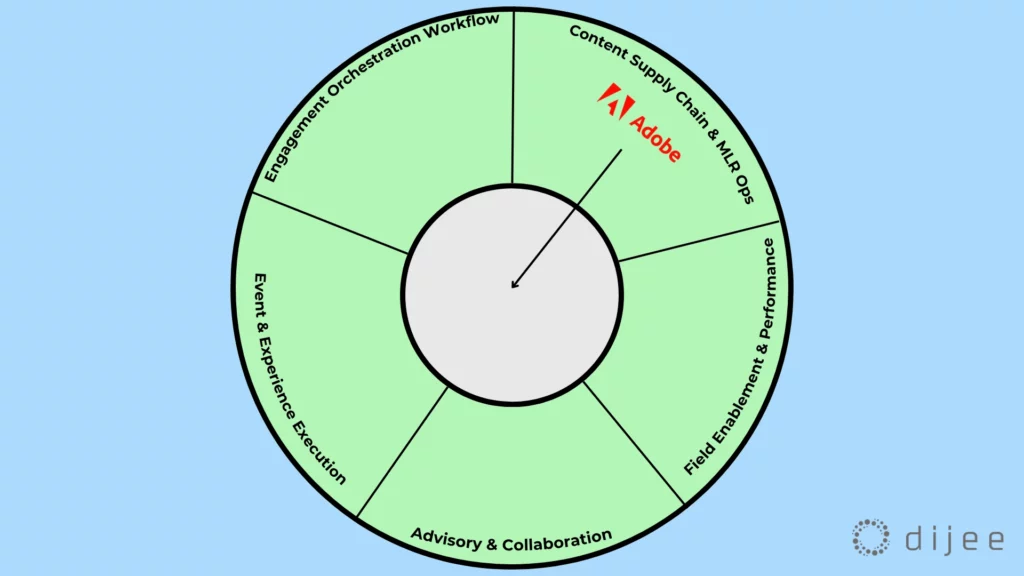
Adobe sits within the Execution & Workflow layer as a content supply chain and experience delivery engine, positioned toward the inner edge due to its operational centrality in content governance and MLR workflows. It maintains a strong inward pull toward the Core, reflecting its reliance on structured data, integration with CRM and analytics systems, and its role in enabling compliant, scalable omnichannel execution.
Capability Impact vs Dependency Gravity
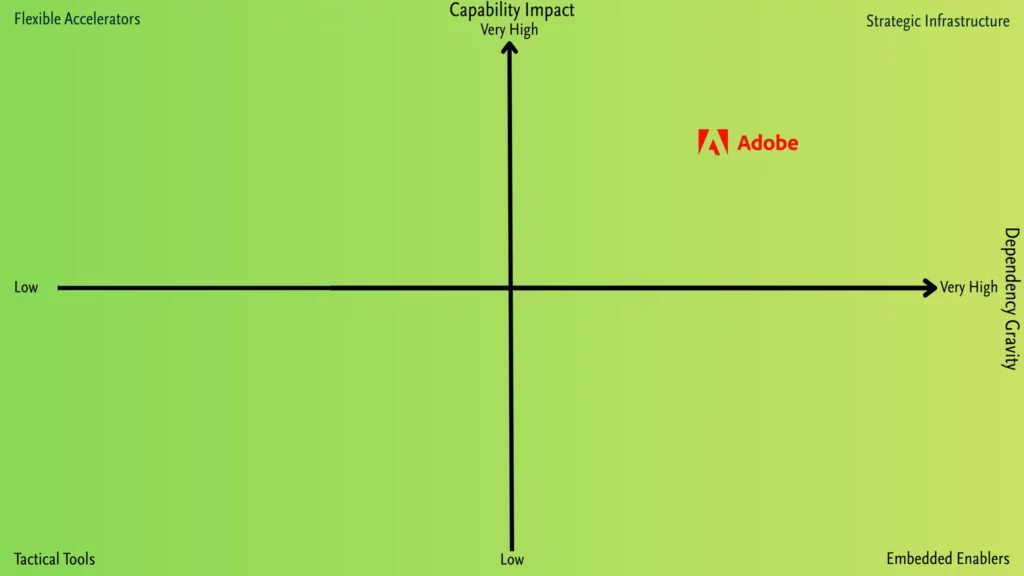
Very high capability (78) versus very high dependency platform positioned within the Strategic Infrastructure quadrant.
To see more visual intelligence in the Execution & Workflow Platforms layer, click here.