

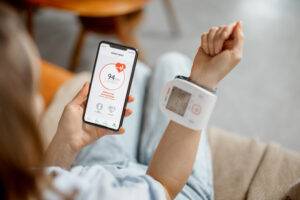

BackgroundAtrial fibrillation, the world’s predominant cardiac arrhythmia, frequently emerges as a complication post-cardiac surgery, leading to serious outcomes like strokes, heart failures, and even death. Due to its often-silent nature, detecting it can be challenging. Smartwatches present a potential solution, offering screening that is more rigorous.ObjectiveThis prospective observational study sought to assess the Withings Scanwatch’s efficacy in identifying postoperative atrial fibrillation.MethodsAfter cardiac surgery, patients received a Withings Scanwatch. Over a span of 24 h, both the smartwatch’s photoplethysmography sensor and standard telemetry kept track of any atrial fibrillation incidents.ResultsAt the end of the study, data from 260 patients was available for assessment. Atrial fibrillation was identified in 32 of these patients, either via telemetry or the smartwatch. Our data revealed a sensitivity of 69.0%, specificity of 98.7%, a positive predictive value of 87.0%, and a negative predictive value of 96.2%.ConclusionsThis clinical study is the first to evaluate the photoplethysmography sensor of the Withings Scanwatch, and it shows that the Scanwatch has high a specificity and moderate sensitivity in detecting postoperative atrial fibrillation. Thus, Scanwatch may support the conventional screening for atrial fibrillation, and potentially reducing complications and costs of atrial fibrillation. Because of lower than expected sensitivity this technology cannot replace conventional monitoring in postoperative patients.

Convolutional automatic identification of B-lines and interstitial syndrome in lung ultrasound images using pre-trained neural networks with feature fusion
IntroductionInterstitial/alveolar syndrome (IS) is a condition detectable on lung ultrasound (LUS) that indicates underlying pulmonary or cardiac diseases associated with significant morbidity and increased mortality