
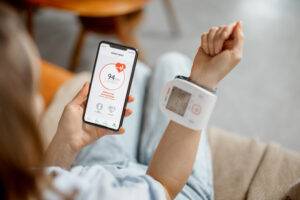


IntroductionThe rapid rise of online healthcare services (OHSs) in China has improved access to medical information and services while creating new uncertainties related to quality, security, and trust. This study aims to deepen the understanding of perceived risk in OHSs and provide empirical guidance for digital health governance, patient safety strategies, and the development of trustworthy online medical platforms.MethodsUsing a grounded theory approach, we analyzed 106,162 user-generated comments collected from four major online health forums to identify the multidimensional structure and temporal evolution of perceived risk in OHSs.ResultsThe analysis produced 22 categories consolidated into four domains: professional-medical, institutional–transactional, technical–data, and relational-emotional , which together constitute a perceived safety–trust model. The model explains how professional uncertainty triggers institutional anxiety, technological fragility heightens perceived vulnerability, and emotional detachment amplifies distrust. The salience of perceived risks shifted over time from professional concerns (2015–2018) to institutional and technical issues (2019–2022), and later to relational-emotional concerns (2023–2024).DiscussionThese findings refine the mechanisms underlying perceived risk in OHSs and show that user trust depends on professional competence, technological reliability, institutional transparency, and empathetic communication.

Development and Evaluation of a Hallucination Awareness Scale for Healthcare Professionals and its impact on diagnostic confidence
Generative artificial intelligence (Gen AI) has gained immense significance in recent years, particularly in the field of healthcare. Despite its significant role in streamlining healthcare-related